

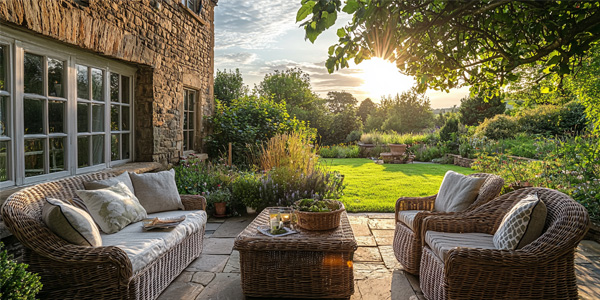
Ever wandered into someone’s garden and thought: “This just works”? There’s something about the flow, the way the plants seem to belong, and – yes – even the bench in the corner that looks like it’s been waiting for a good book and a cup of tea.
Truth is, great gardens don’t happen by accident. But with a bit of thought – and a decent mug of Yorkshire Gold – you can plan a space that grows with you.
Here’s how.
1. Start With a Purpose, Not a Pinterest Board
Before you fall down a visual rabbit hole of French potagers and Kentish cottage beds, ask:
“What do I actually want from this space?”
- Morning coffee spot?
- A space for kids and Labradors to burn energy?
- Or maybe just a quiet plot that smells like lavender and doesn’t argue back?
Purpose first, plants second.
2. Map Your Microclimates (Yes, Even in a Small Garden)
Most UK gardens have at least three microclimates – sun traps, shady pockets, and wind-blasted corners straight off the North Sea.
Spend a few days observing:
- Where the sun hits at 10am, 2pm, 6pm
- Where the frost lingers in April
- What areas feel sheltered even on a blustery Tuesday
Design with those quirks, not against them. No point putting a herb garden where the sun never shines.
3. Think Flow, Not Just Function
Good garden design is about movement – visually and physically.
- Do paths lead somewhere, or fizzle awkwardly near the bins?
- Can you get from the shed to the patio without crushing anything?
- Is there a clear sense of “arrival” at your favourite seating area?
Quick tip: standing at your back door and doing a slow 360° sweep with a notepad is more useful than any app.
4. Divide and Conquer (with Style)
If you’ve got a rectangular plot (like many of us in the UK), one big lawn bordered by flower beds can feel… unfinished. Add definition:
- Use low hedges, trellises, or even a line of planters to break up space
- Raise or sink a section of patio for a layered effect
- Create “rooms” – herbs here, a fire pit nook there
And yes, furniture counts as structure. A well-placed bistro set can do more for your garden’s layout than any pricey paving stone.
5. Pick Plants That Want to Be There
Forget the exotic bird of paradise you saw in Chelsea. Stick with the tried-and-true that thrive in your soil and zone.
For UK gardens:
- Shade? Ferns, foxgloves, astrantia
- Full sun? Lavender, eryngium, verbena bonariensis
- Heavy clay? Dogwood, hydrangeas, hardy geraniums
Build beds like a band: you need lead singers (statement plants), backing vocals (fillers), and solid percussion (evergreens).
6. Don’t Skip the Sit Spots
This is where garden furniture quietly earns its keep.
- A teak bench under a tree isn’t just practical – it anchors the scene
- A small table tucked behind a hedge invites pause, and suddenly your garden isn’t just pass-through space, it’s lived in
Functional? Sure. But also one of the easiest ways to humanise a design.
Bonus: paint your bench in a heritage green and it doubles as a focal point and seating. Win-win.
7. Work With the Seasons, Not Against Them
UK gardens live in transition. Plan for it:
- Spring bulbs under deciduous shrubs = colour before the leaves show
- Summer annuals that carry heat into early autumn
- Winter structure: box balls, grasses, birch bark, evergreen climbers
Design so there’s always something happening. Even if it’s subtle. Even if it’s just a bird feeder getting heavy traffic.
Final Thought: A Garden is Never “Finished”
Truth bomb: no garden is ever done. It’s a dialogue between you and the soil, the seasons, and yes – sometimes the weather that ruins your mulch plans.
But if you start with intention, layer in structure (hello, seating nook), and give it space to evolve, you’ll create something that feels like home – even when it’s muddy.
And that, more than any Chelsea award or fancy slate path, is the point.